
How to Do a Hydrostatic Pressure Test? Step-by-Step Process, Standards and Equipment
A hydrostatic pressure test fills a system with water, pressurises it above its working pressure, and checks for leaks, deformation, or pressure drop.
Whether you are testing boilers, pipelines, pressure vessels, gas cylinders, fire suppression systems, or hydraulic equipment, a hydrostatic pressure test is one of the most important checks before commissioning. It is required under Indian standards, ASME codes, and global regulations.
However, many teams still perform hydro testing without a clear procedure, proper equipment, or a full understanding of each step. This guide explains everything in a simple way: what hydrostatic testing is, the required standards, equipment, and the correct step-by-step process.
What Is a Hydrostatic Pressure Test?
A hydrostatic pressure test is used to check the strength and leak-tightness of pressure equipment by filling it with water and pressurising it above its normal working pressure. The system is then held at that pressure and inspected for leaks, deformation, or pressure drop.
Water is used because it is incompressible, making the test much safer than gas-based testing. If a failure occurs, the energy release is minimal.
Hydrostatic testing is also called hydrotest, hydro pressure testing or hydrostatic pressure testing, and the terms are used interchangeably across the industry. The equipment used to generate the required test pressure is a hydrostatic test pump, also referred to as a hydro test pump, hydro testing pump or hydrotest pump.
Why Hydrostatic Pressure Testing Is Mandatory in India?
In India, hydrostatic pressure testing is not optional for most industrial equipment. It is a statutory requirement enforced through multiple regulatory frameworks depending on the application.
| Regulation / Code | Applies To | Key Requirement |
| IBR 1950 (Indian Boiler Regulations) | Boilers and steam equipment | Mandatory hydrotest before commissioning and at periodic intervals. Test pressure is typically 1.5x working pressure. |
| IS 15100 / IS 7285 | Gas cylinders (LPG, oxygen, CNG) | Hydrostatic test at 1.5x working pressure required before first fill and at every re-qualification. |
| IS 2825 (Unfired Pressure Vessels) | Industrial pressure vessels and tanks | Hydrotest at 1.3x MAWP or 1.5x design pressure, whichever is applicable. |
| ASME B31.3 (Process Piping) | Chemical, oil & gas, refinery piping | Test pressure = 1.5x design pressure. System held for a minimum of 10 minutes. |
| ASME Section VIII Div. 1 (UG-99) | ASME pressure vessels | Test pressure = 1.3x MAWP. No leakage or deformation permitted. |
| API 610 | Centrifugal pumps (casing hydrotest) | Pump casing tested at 1.5x MAWP for a minimum of 30 minutes. |
Equipment Required for a Hydrostatic Pressure Test
To carry out a hydrostatic pressure test, you need a proper setup with all the required equipment in place. Each part is important in building pressure, measuring it correctly, and keeping the test safe. Using the right equipment also helps to ensure the test is correct and meets standard requirements.
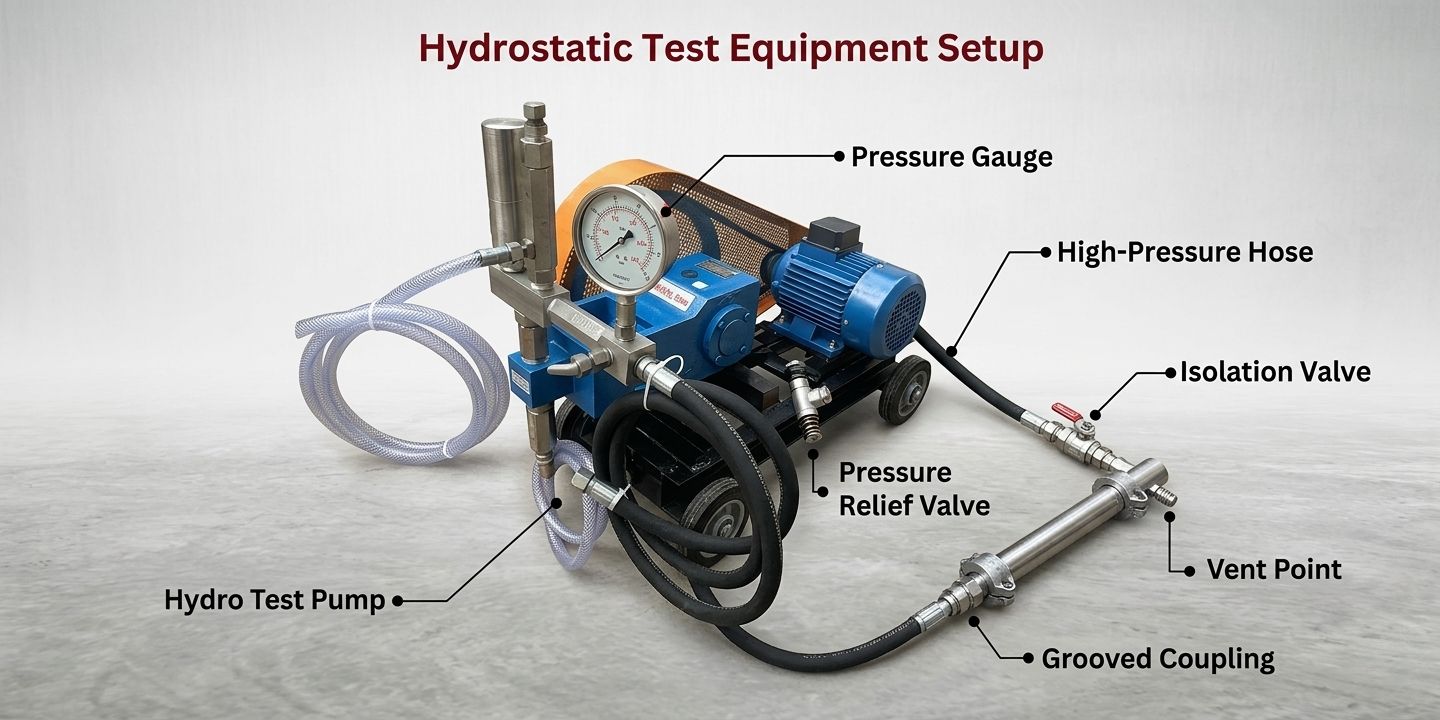
1. Hydrostatic Test Pump
The pump is the main part of the setup. A hydro test pump pushes water into the system to build and hold the required pressure. Always choose a pump with a higher pressure rating than your test requirement (around 25% more) so it runs safely and smoothly.
2. Calibrated Pressure Gauge
The gauge must be calibrated within the last 12 months. Its range should ideally be 2x the test pressure. Never use a gauge whose maximum reading is less than 1.5x or more than 4x the test pressure, as both give inaccurate readings for your range. All Ambica hydro test pumps come fitted with a 4-inch SS304 glycerin-filled pressure gauge as standard.
3. High-Pressure Discharge Hose
Use a rated, braided high-pressure hose that matches or exceeds the test pressure. Inspect hoses for cracks, kinks or coupling damage before every test. Never improvise with standard garden or hydraulic hoses for pressure testing work.
4. Pressure Relief Valve (PRV)
A PRV is non-negotiable. It limits the maximum pressure the system can reach and prevents accidental over-pressurisation. Set the PRV at or slightly above the required test pressure, never higher than the equipment’s rated limit.
5. Isolation Valves and Vent Points
Separate the test section from the rest of the system using isolation valves. Keep vent points open at higher locations while filling so all air can escape. Any trapped air can affect pressure readings and make the test unsafe.
6. Test Record Sheet and Inspection Equipment
Keep a test record sheet ready to note down all details during the test. Use soap solution or marking fluid to check for leaks at joints. For bigger systems, you can also use a chart recorder or data logger to track pressure continuously.
How to Perform a Hydrostatic Pressure Test: Step-by-Step
Follow this sequence for every hydrostatic pressure test, regardless of the equipment being tested. Do not skip steps even on systems that have been previously tested.
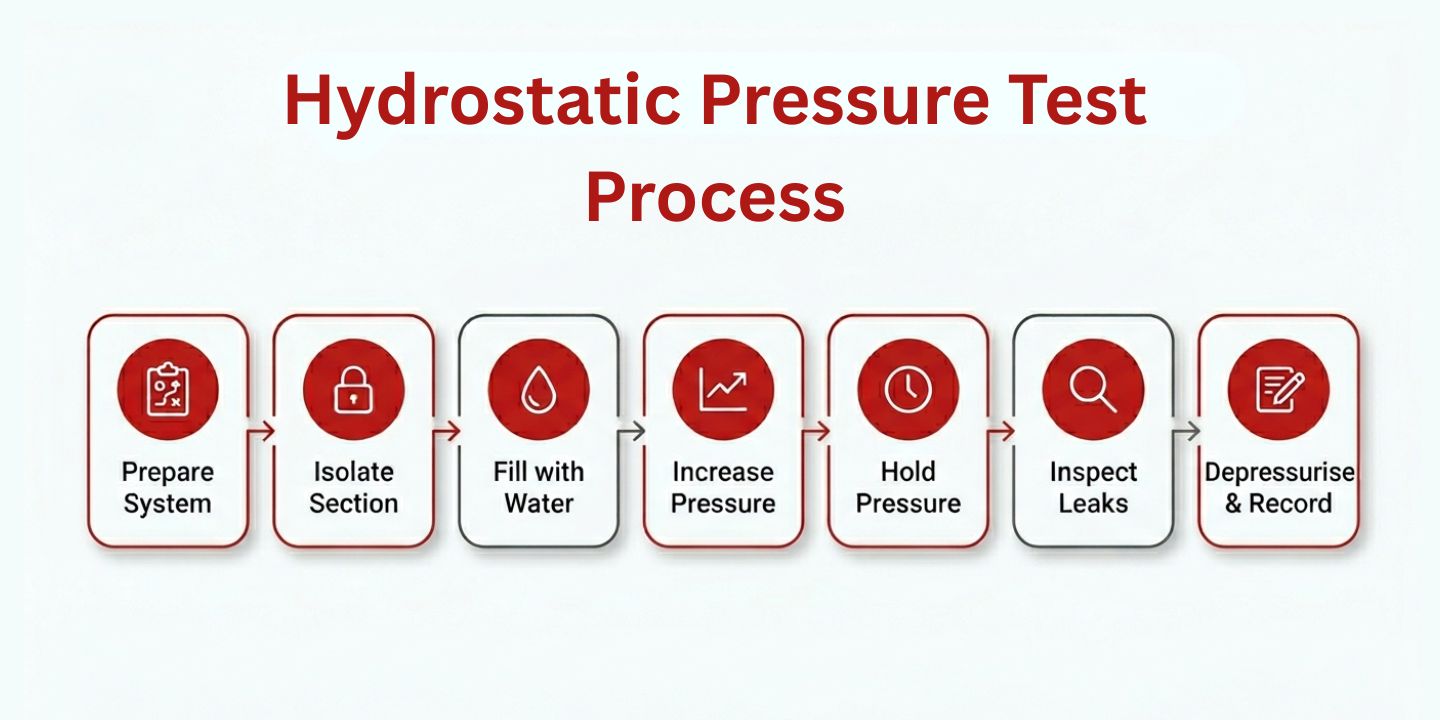
1. Prepare the System
First, calculate the test pressure based on the applicable standard (for example, ASME or IBR). Check drawings and clearly define the test area. Remove or isolate all components that should not be exposed to test pressure, such as instruments and safety valves.
2. Isolate the Test Section
Close all valves around the test area. Disconnect or block off sensitive equipment. Use blind flanges or caps where needed. Make sure no one is working inside the system and set up a safe testing zone.
3. Fill the System with Water
Connect the hydro test pump at the lowest point. Open all vent points and start filling slowly. Make sure all air is removed. When water flows out from all vents, close them. Always use clean water.
4. Increase Pressure Gradually
Do not increase pressure suddenly. Raise it slowly in stages. Start with around half the test pressure, then increase step by step. Pause at each stage and check for any issues.
5. Hold the Test Pressure
Once the required pressure is reached, hold it for the specified time (usually 10 to 30 minutes, depending on the standard). The pressure should remain stable. Any drop may indicate a leak.
6. Inspect for Leaks
Reduce the pressure slightly and inspect all joints, welds, and connections. Use soap solution or marking fluid to find small leaks. Any leakage means the test has failed.
7. Depressurise and Record Results
Release the pressure slowly using a valve. Drain the water completely. Reconnect all removed parts. Record all details such as pressure, time, and results. Keep a signed test report for future reference.
Common Mistakes to Avoid During Hydrostatic Testing
Not venting air fully before pressurising
Trapped air makes the system compressible and unsafe. Always fill from the bottom and vent from all high points until water flows out completely.
Using an uncalibrated pressure gauge
Gauges must be calibrated within the last 12 months. Uncalibrated gauges are not accepted under IS, ASME, or IBR standards.
Pressurising too fast
Rapid pressure increase can cause sudden failure and hide leaks. Always raise pressure gradually in stages.
Testing without isolating components
Instruments like safety valves and transmitters may get damaged if not isolated. Always remove or isolate non-test components.
Not recording the test
A hydrostatic pressure test without proper documentation is not valid. Always record pressure, time, date, and inspection results.
Ignoring temperature changes
Temperature variations can affect pressure readings. Account for this during outdoor testing, especially in hot conditions.
Safety Guidelines for Hydrostatic Pressure Testing
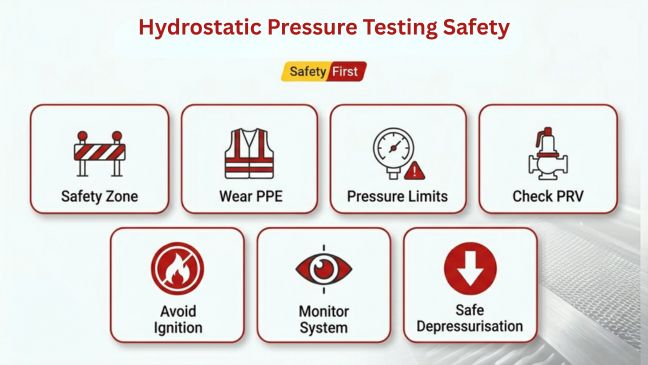
Hydrostatic testing is safer than pneumatic testing, but it still involves risks. Follow these safety precautions on every job:
Set up a safety exclusion zone: Keep all personnel away from joints, flanges, and connections during pressurisation.
Wear proper PPE: Use safety glasses, gloves, and safety footwear. High-pressure water leaks can cause serious injuries.
Do not exceed test pressure limits: Always follow the pressure defined by applicable codes. Never exceed the rating of hoses, pumps, or fittings.
Check the pressure relief valve (PRV): Ensure the PRV is properly set and working before starting. Test it separately if needed.
Avoid ignition sources: Do not use the hydro test pump near ignition sources if the fluid is not clean water.
Never leave the system unattended: Monitor the system continuously during the test hold period.
Depressurise safely after testing: Release pressure slowly and completely before opening or disconnecting any part of the system.
Conclusion
A hydrostatic pressure test is a reliable way to check the safety and strength of pressure equipment. When done properly, with correct preparation, proper filling, gradual pressurising, and careful inspection, it gives accurate results and meets required standards. Using a good hydro test pump is also important. A reliable and properly calibrated pump helps avoid errors and ensures the test runs smoothly.
Need a Hydrostatic Test Pump for Your Application?
Ambica Machine Tools manufactures manual hydro test pumps and motorised hydro test pumps from 35 kg/cm2 to 1000 kg/cm2, with all critical components in SS304. Fast delivery across India. Contact us today to know more about pumps.