
Manual vs Motorised Hydro Test Pump: Which One is Right for Your Application?
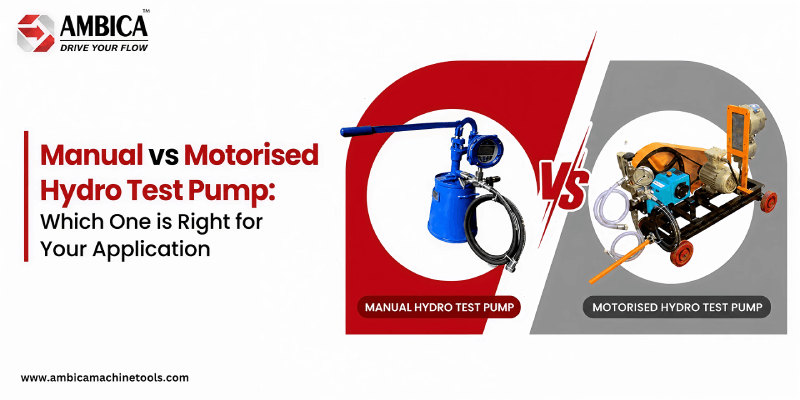
Picked wrong hydro test pump? You waste hours pumping by hand on a job that needed a motor. Or you lug a 40 kg motorised unit to a site where a manual pump would have finished the test in 10 minutes. Both cost time, money, and credibility. This guide settles the manual vs motorised question in five minutes, so your next pressure test runs clean, fast, and accurate, whether you are testing a small water line or a 2 km pipeline.
What is a Hydro Test Pump?
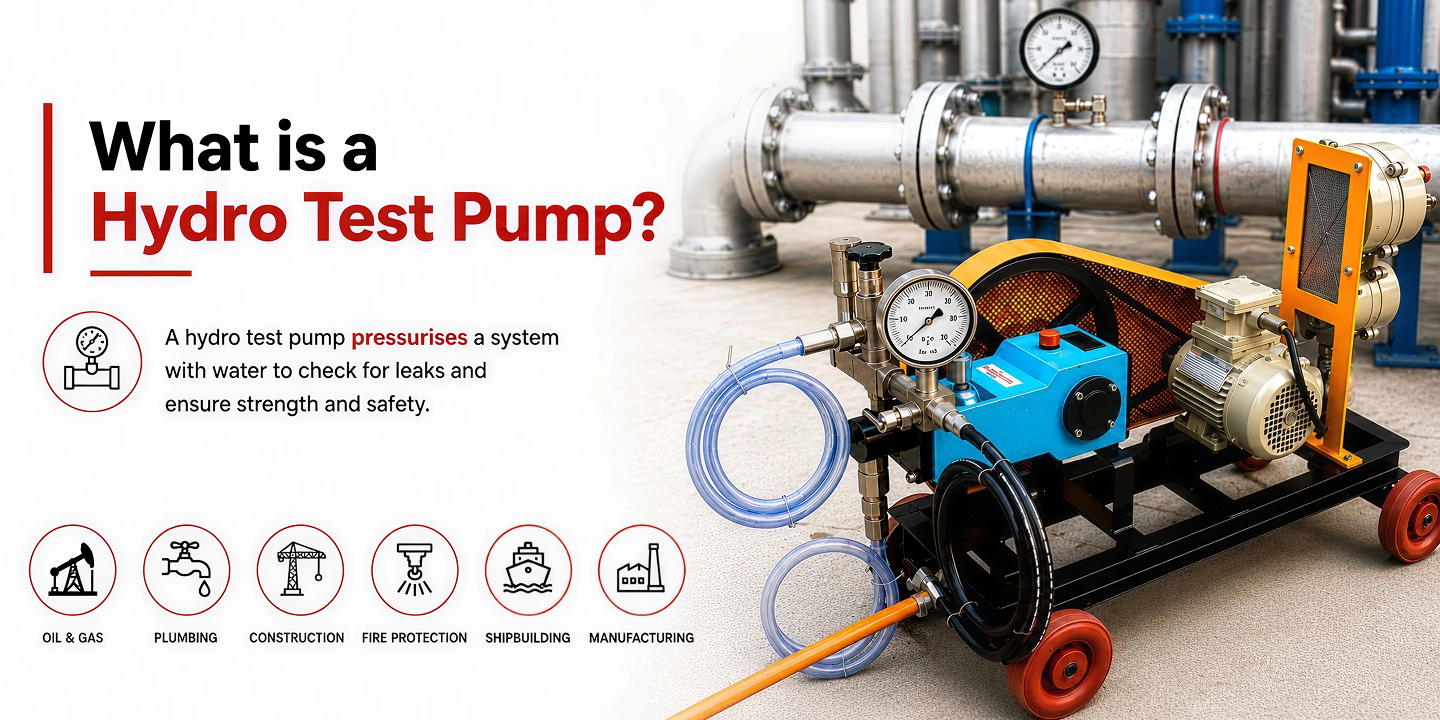
A hydro test pump is a specialised device used to fill a system with water or another fluid and then pressurise it to a level higher than its normal operating pressure. This process checks for leaks, structural weaknesses, or pressure drop in pipes, valves, cylinders, and other pressure-bearing equipment.
Hydrostatic test pumps are widely used across industries, including oil and gas, plumbing, construction, fire protection, shipbuilding, and manufacturing. They are available in two primary configurations: manual and motorised.
What is a Manual Hydro Test Pump?
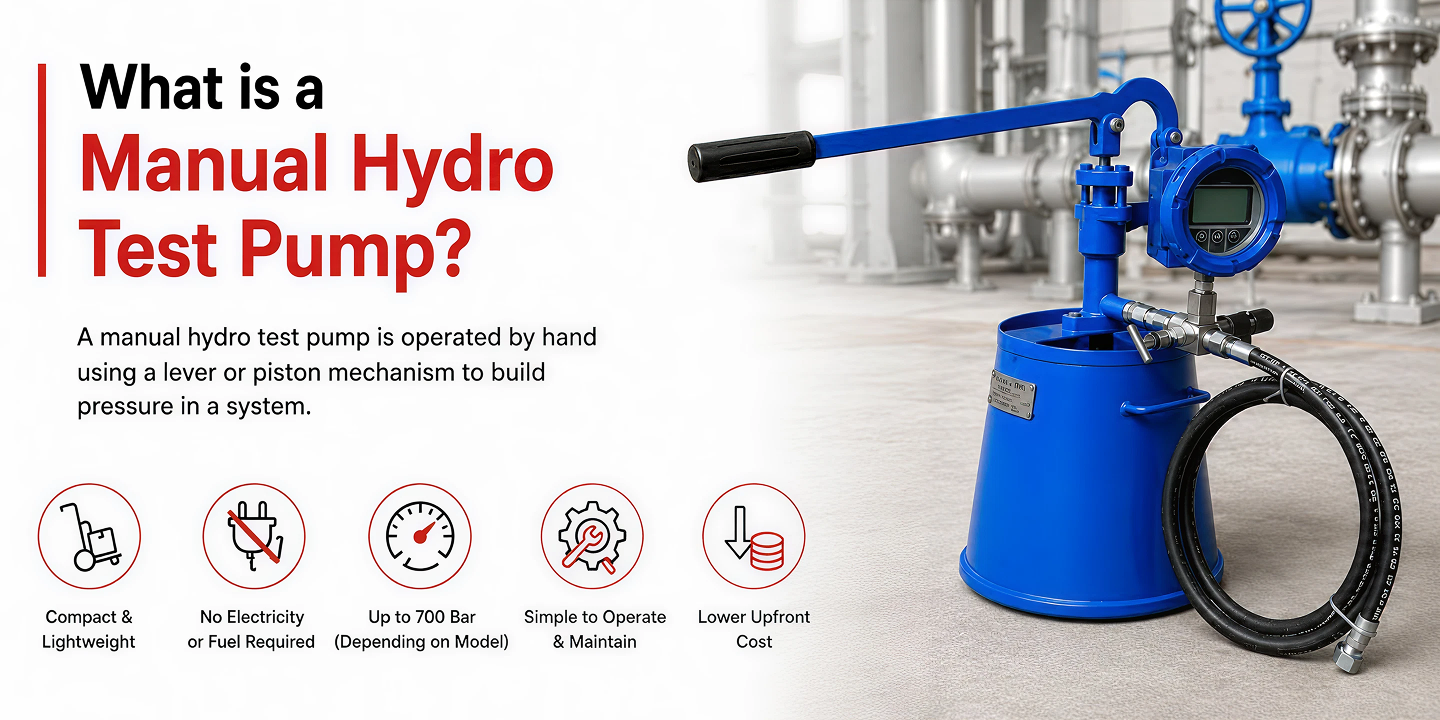
A manual hydro test pump is operated by hand using a lever or piston mechanism. The operator manually pumps fluid into the system to build up pressure gradually.
Key features of a manual hydro test pump:
- Compact and lightweight design, ideal for field use
- No electricity or fuel required, making it fully portable
- Suitable for low to medium pressure applications (typically up to 700 bar depending on the model)
- Simple to operate and maintain with fewer moving parts
- Lower upfront cost compared to motorised models
Manual pumps are the preferred choice for plumbers, maintenance teams, and contractors who need a portable, quick-setup solution for on-site pressure testing of water lines, gas pipes, and small vessels.
What is a Motorised Hydro Test Pump?
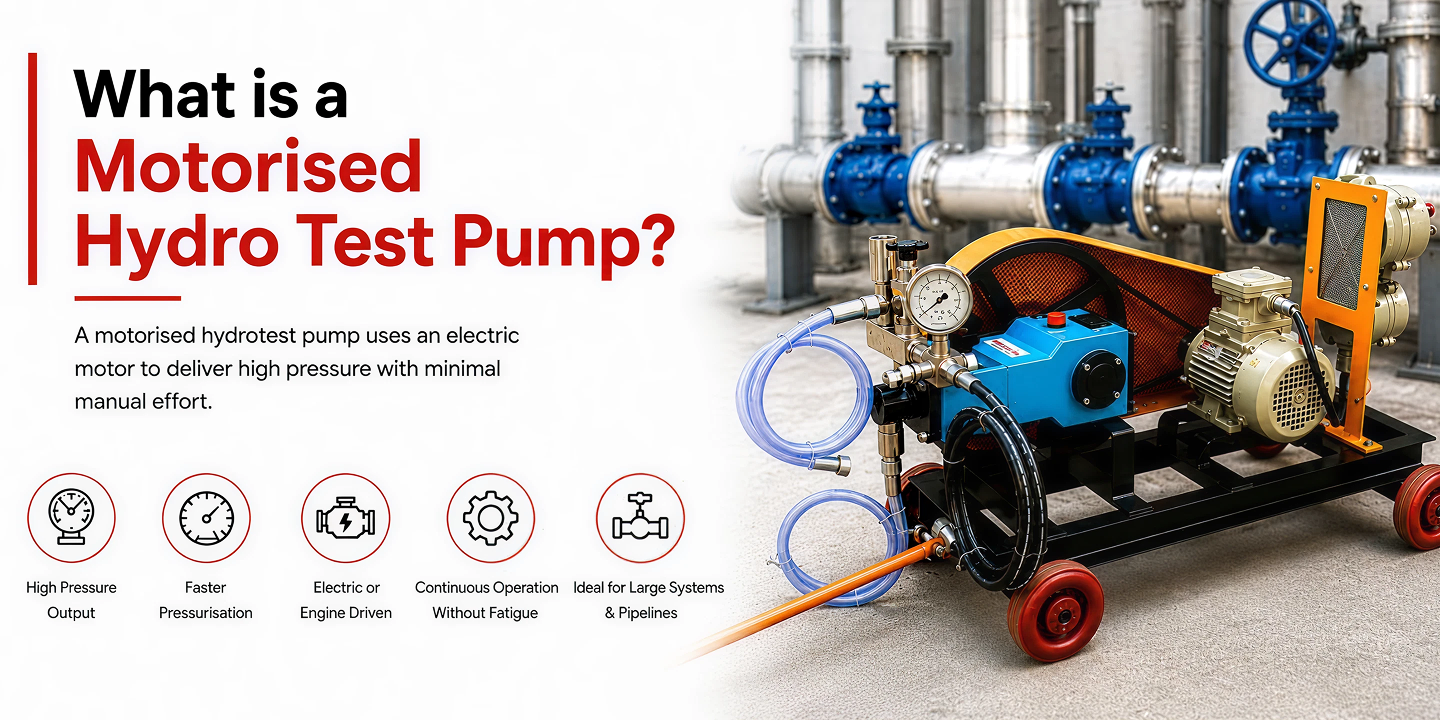
A motorised hydrotest pump uses an electric motor or a petrol/diesel engine to power the pumping action. This eliminates the need for manual effort and delivers consistent, high-volume flow rates.
Key features of a motorised hydro test pump:
- Capable of achieving very high pressures continuously without operator fatigue
- Suitable for large-scale and industrial applications
- Faster pressurisation of larger systems and pipelines
- Available in electric and engine-driven variants
- Ideal for testing long pipelines, large pressure vessels, and heavy-duty equipment
- Higher output volume makes it suited for testing systems that require significant fluid volume
Motorised pumps are commonly used in industries such as oil and gas, chemical processing, power generation, and large-scale construction, where sustained high pressure over extended testing cycles is required.
Key Differences: Manual vs Motorised Hydro Test Pump
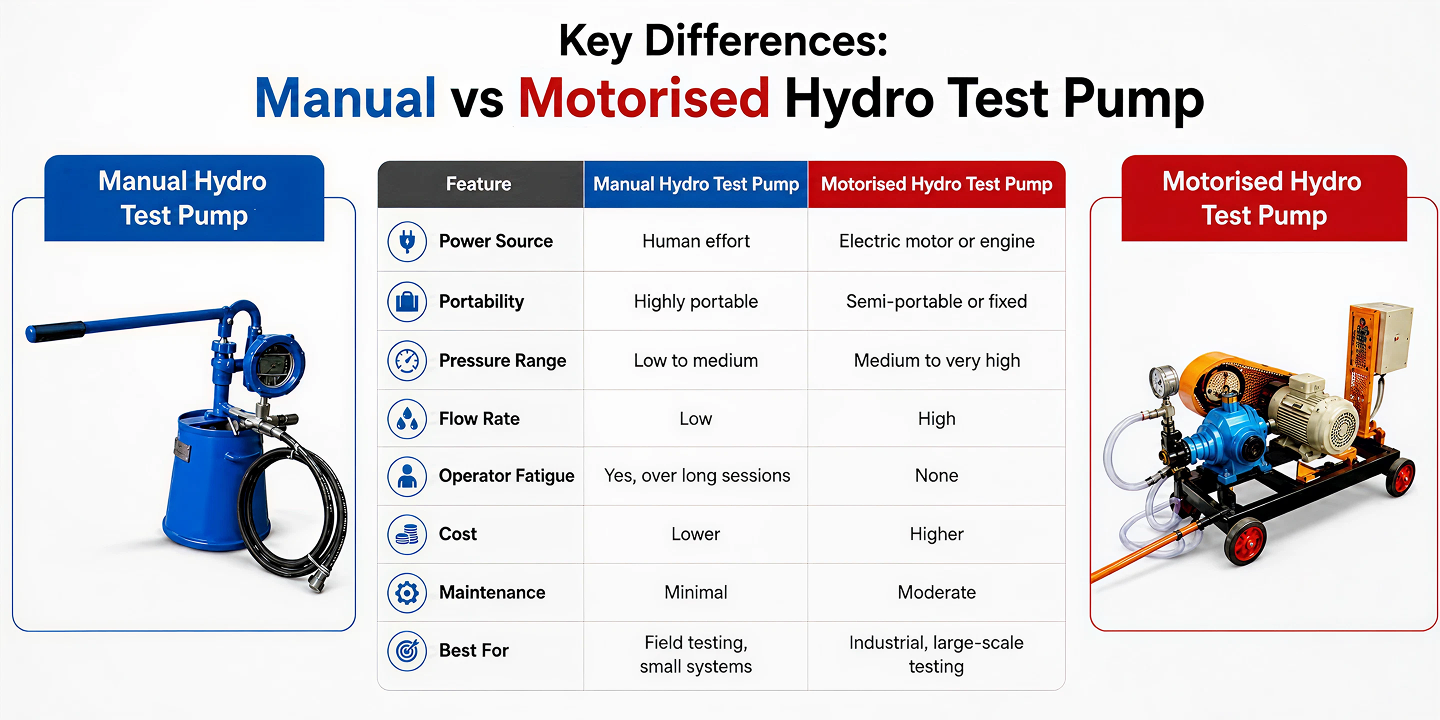
| Feature | Manual Hydro Test Pump | Motorised Hydro Test Pump |
| Power Source | Human effort | Electric motor or engine |
| Portability | Highly portable | Semi-portable or fixed |
| Pressure Range | Low to medium | Medium to very high |
| Flow Rate | Low | High |
| Operator Fatigue | Yes, overlong testing sessions | None |
| Cost | Lower | Higher |
| Maintenance | Minimal | Moderate |
| Best For | Field testing, small systems | Industrial, large-scale testing |
Which One Should You Choose?
The right choice depends on three main factors: your required pressure range, the volume of the system being tested, and your working environment.
Choose a manual hydro test pump if:
- You are a plumber or contractor testing residential water lines on site
- Your test pressure stays under 700 bar
- The test location has no reliable power supply (rural site, rooftop, or basement)
- You are testing small vessels, gas pipes, sprinkler lines, or single fire hydrant valves
- Budget is tight and the job does not justify a motorised unit
Choose a motorised hydrostatic test pump if:
- You are testing pipelines longer than 500 metres, large pressure vessels, or boilers
- The test holds pressure for 30 minutes or more (manual pumping kills accuracy)
- Required pressure crosses 700 bar, or the system volume is high
- You run multiple tests per day, and manual pumping eats production time
- Your project is oil and gas, power plant, chemical processing, or shipyard work
For a detailed guide on what to look for before buying, read our blog: Points to Consider While Selecting a Hydraulic Test Pump
Where Does a Hydro Jet Pump Fit In?
Many plants run both processes back to back: clean the pipeline, then pressure test it. A hydro jet pump handles the first half. Instead of pressurising a closed system, it fires a high-pressure water jet to strip scale, rust, and residue from pipe interiors, drains, and industrial surfaces. If your workflow needs both cleaning and testing, a combination setup saves capex and floor space. Ask our team if your application qualifies.
Frequently Asked Questions
What is the difference between a manual and a motorised hydro test pump?
A manual hydro test pump is operated by hand using a lever or piston mechanism, making it ideal for portable, low to medium-pressure applications. A motorised hydro test pump uses an electric motor or engine to generate pressure automatically, making it suitable for large-scale, high-pressure, and continuous testing operations where manual effort would not be practical.
Which hydro test pump is better for on-site fieldwork?
A manual hydro test pump is the better choice for fieldwork. It is compact, lightweight, requires no power supply, and can be carried to remote locations easily. Plumbers, contractors, and maintenance teams typically prefer manual pumps for testing water lines, gas pipes, and small pressure systems on-site.
What pressure can a manual hydro test pump achieve?
Depending on the model and build, a manual hydro test pump can achieve pressures of up to 700 bar. However, for sustained high-pressure testing over long durations, a motorised hydrostatic test pump is more practical as it eliminates operator fatigue.
When should I use a motorised hydrostatic test pump instead of a manual one?
You should use a motorised hydrostatic test pump when testing large pipelines, pressure vessels, boilers, or industrial systems that require continuous, high-pressure output over extended periods. If your application demands pressures that a manual pump cannot sustain comfortably, or if the system volume is large and requires significant fluid to reach test pressure, a motorised pump is the right choice.
Can a manual hydro test pump be used for industrial applications?
Manual hydro test pumps can be used for certain industrial applications where the system volume is small, and the required test pressure falls within the manual pump’s rated capacity. However, for heavy-duty or continuous industrial testing, a motorised or triplex hydrostatic test pump is generally more efficient and reliable.
What maintenance does a motorised hydro test pump require?
Motorised hydrostatic test pumps require periodic maintenance including checking and replacing seals and packings, inspecting the motor or engine, lubricating moving parts, and verifying pressure gauge calibration. Compared to manual pumps, motorised models have more components and therefore require a more structured maintenance schedule.
Conclusion
The right pump is the one that matches your pressure, volume, and site reality. Pick manual for portable, low to medium-pressure jobs where simplicity wins. Pick motorised when scale, speed, and sustained pressure decide the outcome. The wrong pick wastes hours; the right pick passes the test on the first attempt.
At Ambica Machine Tools, we manufacture a complete range of hydrostatic test pumps built for reliability and precision across all pressure ranges. Whether you need a compact manual hydro test pump for field work or a heavy-duty motorised unit for industrial testing, we have the right solution for your application.
Contact us today to discuss your project needs and receive expert guidance in selecting the most suitable hydro test pump for your application. For more detailed information, feel free to email us at info@ambicamachinetools.com or call us at +919601253837. Our team will be happy to assist you.