
What is an AODD Pump? A Complete Guide to Air Operated Double Diaphragm Pumps
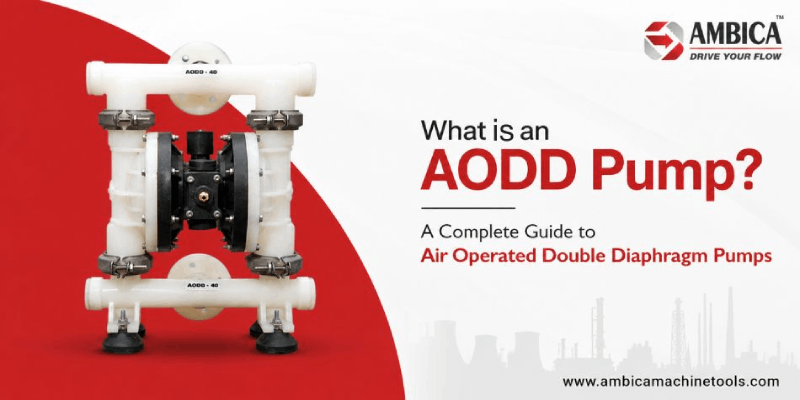
Table of Content:
- What Is an AODD Pump?
- How Does an AODD Pump Work? (Working Principle)
- Main Parts of an AODD Pump
- Key Benefits of AODD Pumps
- Common Applications of AODD Pumps
- What to Check Before Buying an AODD Pump
- Frequently Asked Questions
- What Does AODD Stand For?
- How Does an AODD Pump Work in Simple Terms?
- How Often Should AODD Pump Diaphragms Be Replaced?
- What Are the Main Advantages of an AODD Pump?
- What Is the Difference Between an AODD Pump and a Centrifugal Pump?
- Where Are AODD Pumps Commonly Used?
- What is the difference between an AODD pump and a hydro test pump?
- Conclusion
If you handle fluids in a chemical plant, pharmaceutical unit, food or dairy facility, or any process plant, you have probably heard the term AODD pump. But what is an AODD pump, and why do so many industries rely on it? An AODD pump, short for air operated double diaphragm pump, is a positive displacement pump powered by compressed air instead of an electric motor. It moves liquids using two flexible diaphragms that push and pull fluid through the pump in a steady cycle.
As an experienced AODD pump manufacturer, Ambica Machine Tools designs reliable pumping solutions for a wide range of industrial fluid handling applications, from chemical processing to wastewater treatment.
This complete guide, prepared by the engineering team at Ambica Machine Tools, explains how the pump works, the parts inside it, its main benefits, common applications, and what to check before you buy one. Whether you are new to fluid handling or comparing pump types for a project, this article gives you the full picture in plain language.
What Is an AODD Pump?
An AODD pump is a compressed-air-driven pump that transfers fluid through the flexing of two diaphragms. The letters stand for Air Operated Double Diaphragm. Because it uses air pressure rather than electricity to create motion, it has no motor, no seals on a rotating shaft and no complex drive train.
The pump belongs to the positive displacement family. That means it captures a fixed volume of fluid and forces it out with each stroke, giving a consistent output regardless of changing system pressure. This makes AODD pumps a dependable choice for thick, abrasive, shear-sensitive, or hazardous liquids that other pump types struggle to handle.
A typical unit has two liquid chambers, two diaphragms connected by a central shaft, an air valve, and four check valves (the ball-and-seat type, also called ball checks or non-return valves). Compressed air enters one chamber, pushes a diaphragm, and the linked diaphragm on the other side pulls fluid in at the same time. The air valve then switches sides, and the cycle repeats.
How Does an AODD Pump Work? (Working Principle)
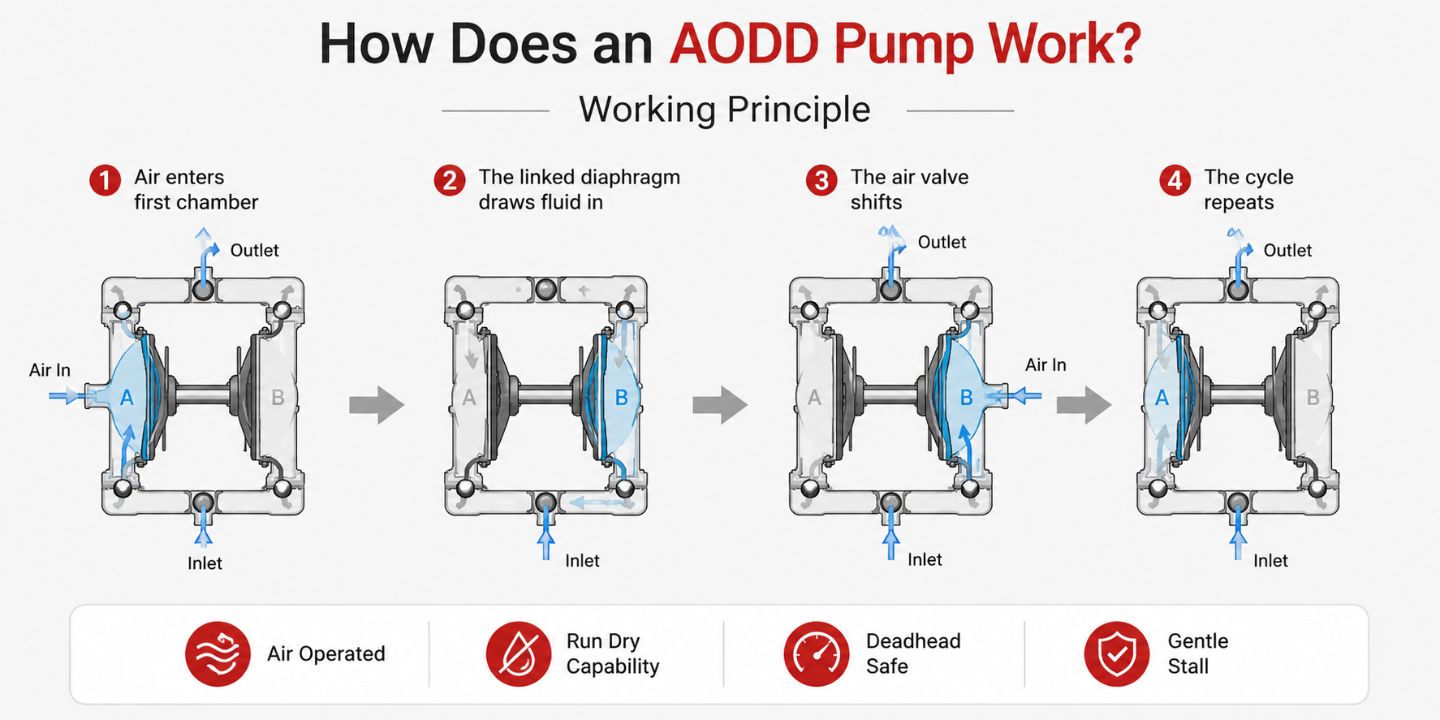
The AODD pump’s working principle is a simple back-and-forth cycle. Understanding it helps you size, run, and troubleshoot the pump correctly.
Step 1: Air enters the first chamber
Compressed air is directed into the air chamber behind diaphragm A. The air pressure pushes diaphragm A outward, which discharges the fluid held in front of it through the outlet check valve.
Step 2: The linked diaphragm draws fluid in
Because both diaphragms share a central connecting rod, when diaphragm A pushes out, diaphragm B is pulled inward. This creates suction on the B side, opening the inlet check valve and drawing new fluid into that chamber.
Step 3: The air valve shifts
Once diaphragm A reaches the end of its stroke, the air valve automatically redirects compressed air to the chamber behind diaphragm B. The roles now reverse: B discharges while A fills.
Step 4: The cycle repeats
This alternating motion continues for as long as air is supplied, producing a smooth and reliable flow. The four check valves make sure fluid only travels in one direction, from inlet to outlet.
Because the pump is driven only by air, it can safely run dry, sit under a deadhead (closed discharge) without damage, and stall gently when downstream pressure matches supply pressure. These traits set it apart from centrifugal and gear pumps.
Main Parts of an AODD Pump
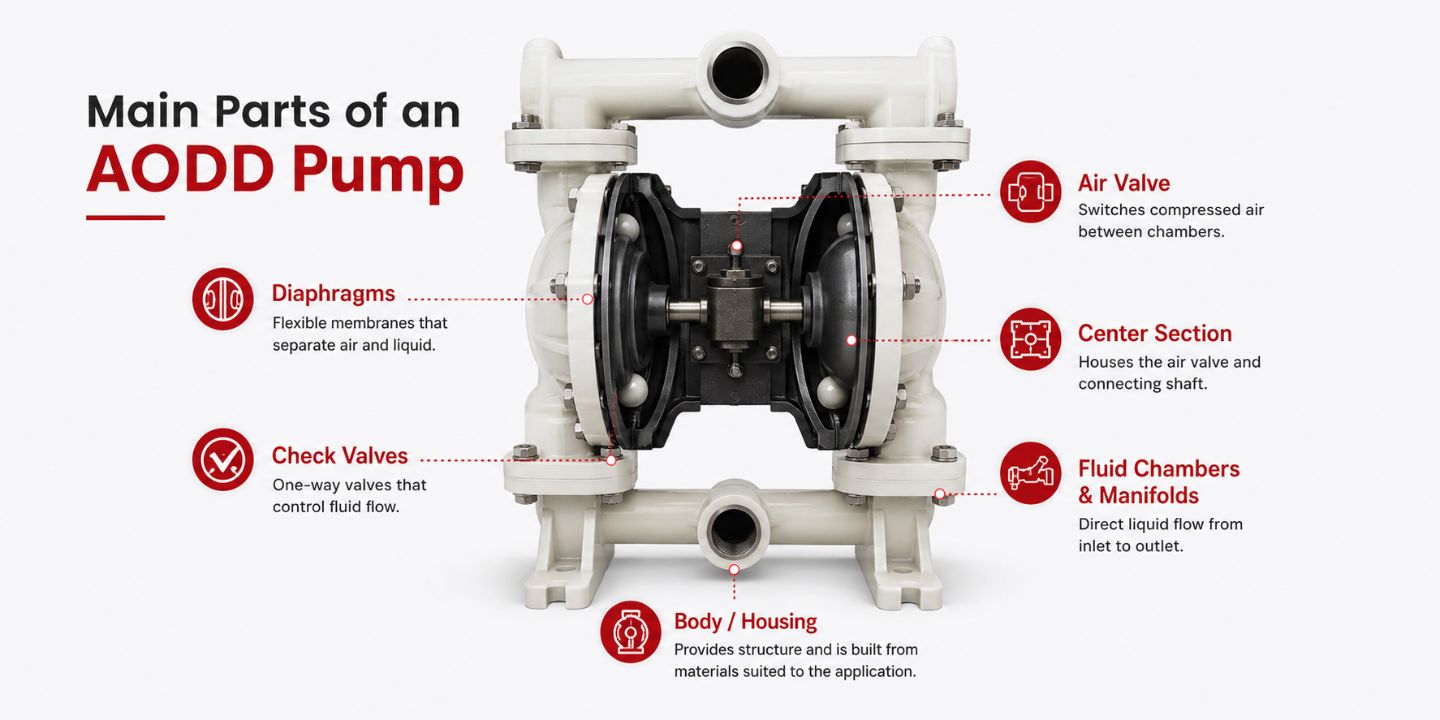
Knowing the components makes maintenance far easier. The core parts include:
Diaphragms: Two flexible membranes that separate the air side from the liquid side. They are the heart of the pump and are made from rubber, TPE (thermoplastic elastomer), or PTFE, depending on the fluid.
Air valve (distribution valve): The mechanism that switches compressed air between the two chambers to keep the cycle going.
Check valves (balls and seats): Four one-way valves that control the direction of fluid flow through the inlet and outlet.
Centre section: Houses the air valve and connecting shaft that link the two diaphragms.
Fluid chambers and manifolds: The wetted passages that carry liquid from the inlet, through the chambers, to the outlet.
Body or housing: Built from plastics such as polypropylene or PVDF, or metals such as aluminium and stainless steel, chosen to suit the fluid and environment.
Key Benefits of AODD Pumps
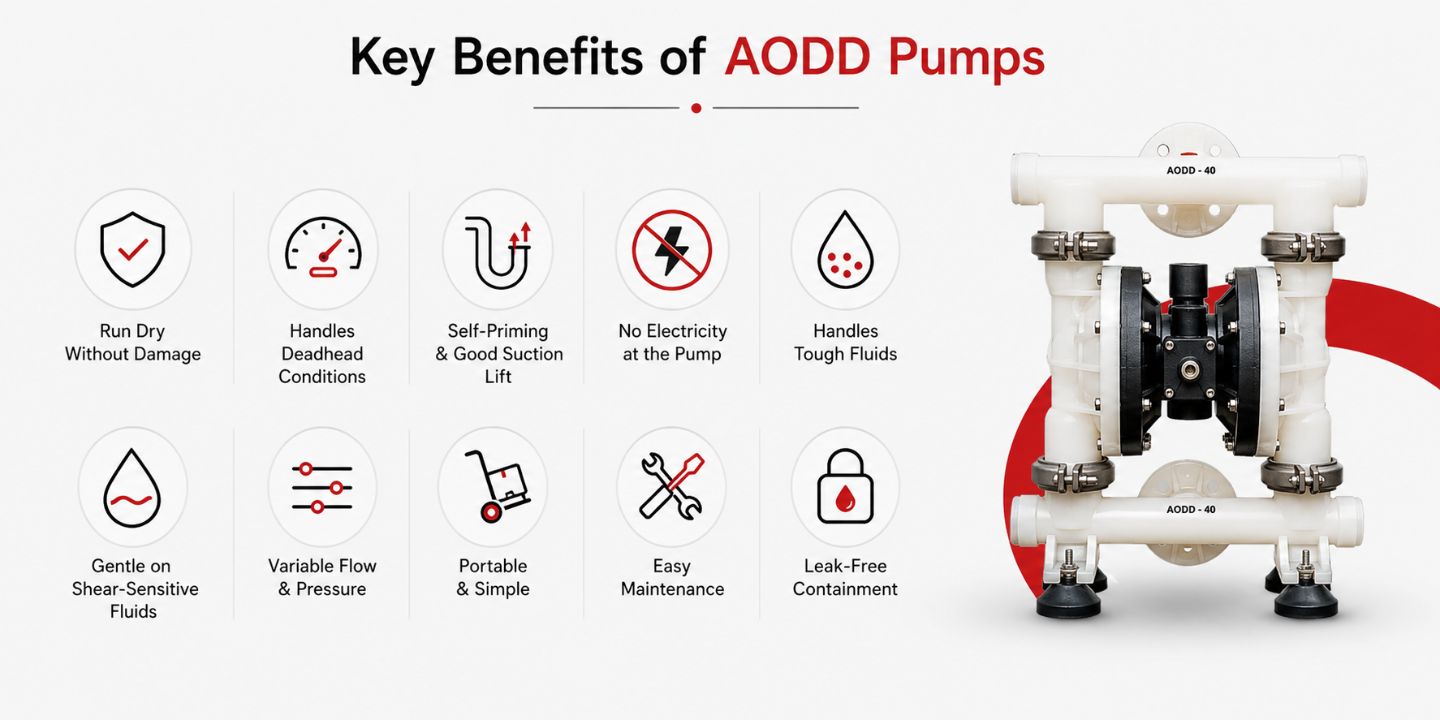
AODD pumps have earned a strong reputation across the industry for good reason. Here are the main benefits.
Run dry without damage: The pump can operate with no fluid present and suffer no harm, which protects it during priming or when a tank empties.
Handles deadhead conditions: If the discharge line is closed, the pump simply stalls and holds pressure instead of overheating or breaking.
Self-priming and good suction lift: It can pull fluid up from below the pump, so it does not always need to be flooded.
No electricity at the pump: Because it runs on air, it is ideal for hazardous, explosive or wet areas where electric motors are a risk. This makes it a safe fit for flammable solvents and volatile chemicals.
Handles tough fluids: Viscous liquids, slurries, abrasive fluids, and products with solids in suspension all move well through an AODD pump.
Gentle on shear-sensitive fluids: The low shear action protects delicate products such as latex, food emulsions, and some paints.
Variable flow and pressure: Simply adjusting the air supply changes the flow rate and pressure, giving easy on-site control.
Portable and simple: With few moving parts and no motor, the pump is compact, easy to move, and quick to repair.
Leak-free containment: The sealed diaphragm design keeps hazardous fluids safely contained, an important safety feature in chemical handling.
Common Applications of AODD Pumps
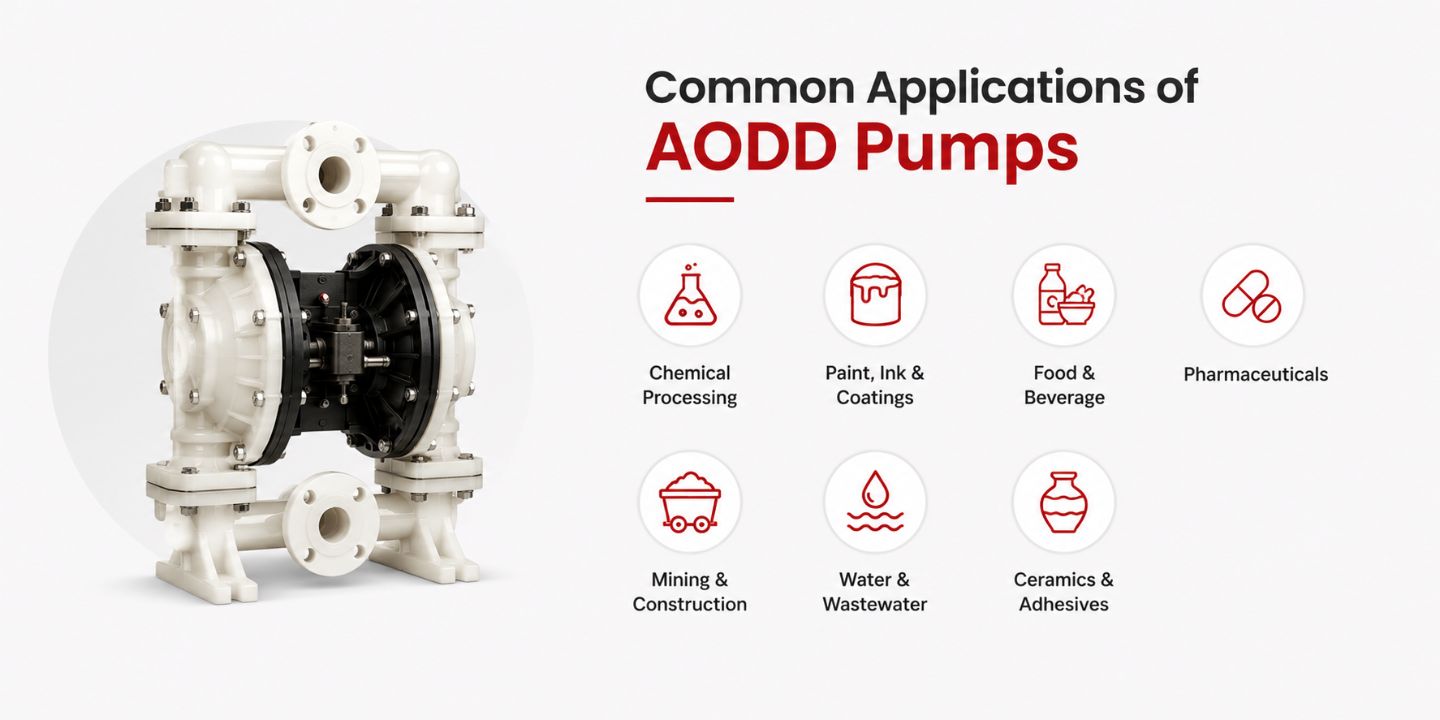
The flexibility of the air operated double diaphragm pump means it appears in almost every processing industry. Typical uses include:
- Chemical and petrochemical processing: transferring acids, solvents, and corrosive liquids
- Paint, ink, and coatings: moving pigmented and shear-sensitive products
- Food, beverage, and dairy: handling syrups, sauces, milk, and other viscous products with sanitary designs
- Pharmaceuticals and cosmetics: clean transfer of sensitive formulations
- Mining, coal, and construction: dewatering, moving slurries, and abrasive mud
- Water and wastewater: sludge transfer and pit dewatering
- Electroplating and metal finishing: transferring plating chemicals and acids
- Ceramics, adhesives, and resins: pumping thick, high-solids materials
- Batteries and agrochemicals: safe handling of aggressive and hazardous liquids
Because these pumps tolerate solids and abrasives that would wreck other designs, they are often the default choice on messy, demanding jobs.
What to Check Before Buying an AODD Pump
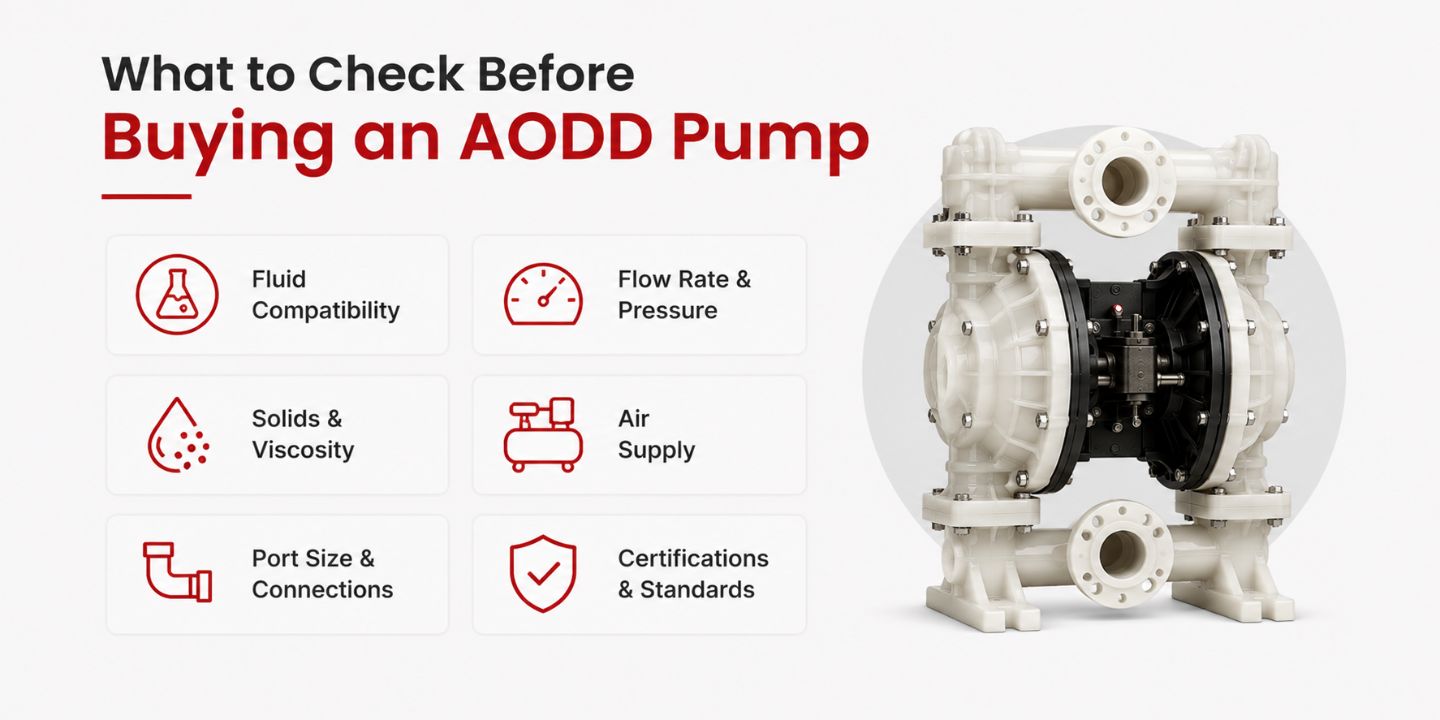
Before you invest, match the pump to your fluid and duty:
Fluid compatibility: Choose body and diaphragm materials that resist your chemical. PTFE diaphragms suit aggressive fluids, while rubber suits general duties.
Flow rate and pressure: Confirm the pump delivers the volume you need at your required discharge pressure.
Solids and viscosity: Check the maximum particle size and viscosity that the model can pass.
Air supply: Make sure you have enough clean, dry compressed air at the right pressure. Because air is the main running cost over the pump’s life, ask about air consumption efficiency when comparing models.
Port size and connections: Match the inlet and outlet to your piping.
Certifications: For food, pharma, or hazardous areas, verify the pump meets the relevant standards.
Buying from an experienced AODD pump manufacturer ensures the materials, build quality, and after-sales support match industrial demands.
Frequently Asked Questions
What does AODD stand for?
AODD stands for Air Operated Double Diaphragm. It describes a positive displacement pump that is driven by compressed air rather than an electric motor and uses two flexible diaphragms working together to move fluid. The term is used interchangeably with air operated diaphragm pump, air diaphragm pump, and double diaphragm pump.
How does an AODD pump work in simple terms?
An AODD pump works by using compressed air to push one diaphragm outward while pulling the second diaphragm inward at the same time. One side discharges fluid while the other side draws in fresh fluid, then an air valve switches the air to the opposite side, and the cycle reverses. Four check valves keep the fluid flowing in one direction, from the inlet to the outlet, which produces a steady and reliable flow.
How often should AODD pump diaphragms be replaced?
Diaphragm replacement depends on the fluid, cycle rate, temperature, and diaphragm material, so there is no fixed interval. As a rule, inspect diaphragms regularly and replace them at the first sign of wear, cracking, or leakage. Signs of a failed diaphragm include fluid appearing in the air exhaust or air bubbling into the fluid line.
What are the main advantages of an AODD pump?
The main advantages of an AODD pump are that it can run dry, handle deadhead (closed discharge) conditions, self-prime, run without electricity, and move difficult fluids with solids or high viscosity. It also offers leak-free containment, variable flow through simple air adjustment, and easy maintenance thanks to few moving parts.
What is the difference between an AODD pump and a centrifugal pump?
The key difference is that an AODD pump is a positive displacement pump that delivers consistent flow even as pressure changes, can run dry, and can handle solids and viscous fluids, while a centrifugal pump relies on a spinning impeller and loses flow as pressure rises. Centrifugal pumps suit high-volume, low-viscosity, clean liquids, whereas AODD pumps suit tough, variable, or hazardous duties.
If your application primarily involves clean, low-viscosity liquids at high flow rates, consulting a trusted centrifugal pump manufacturer in India can help you select the most suitable pumping solution for your system.
Where are AODD pumps commonly used?
AODD pumps are commonly used in chemical processing, paint and coatings, food and beverage, pharmaceuticals, mining, construction, water and wastewater treatment, ceramics, and adhesives. They are often chosen for transferring corrosive, abrasive, viscous, or shear-sensitive fluids.
What is the difference between an AODD pump and a hydro test pump?
An AODD pump is used to transfer liquids, including chemicals, slurries, and viscous fluids, using compressed air. A hydro testing pump is designed to generate high pressure for leak and pressure testing of pipelines, valves, and other equipment. In short, AODD pumps move fluids, while hydro testing pumps perform pressure tests.
Conclusion
An AODD pump is a versatile, air-powered positive displacement pump that moves difficult fluids reliably, runs dry without harm, and keeps hazardous liquids safely contained. Its simple design and easy maintenance make it a trusted choice for modern industrial applications.
Whether you need an AODD pump or a Manual Hydro Test Pump for pressure testing applications, selecting high-quality equipment from a trusted manufacturer is essential for long-term performance and reliability.
For robust, industry-grade pumps and pressure testing equipment backed by strong engineering support, Ambica Machine Tools is a name that manufacturers across sectors rely on.
Contact us today for expert guidance or to request a quotation. Email us at: info@ambicamachinetools.com or call us on: +91 9601253837.