
What Are the Main Uses of a Hydro Jet Pump?
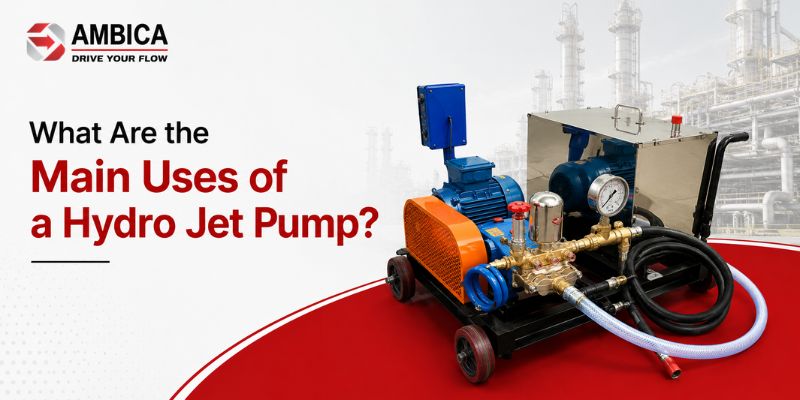
Table of Content:
Scale builds inside boiler tubes. Sludge hardens at the bottom of a storage tank. Old paint clings to a ship hull. Chemicals soften some of this, and scrapers handle a little more, but plants that need the deposit gone in one shift reach for water at high pressure instead.
What Is a Hydro Jet Pump?
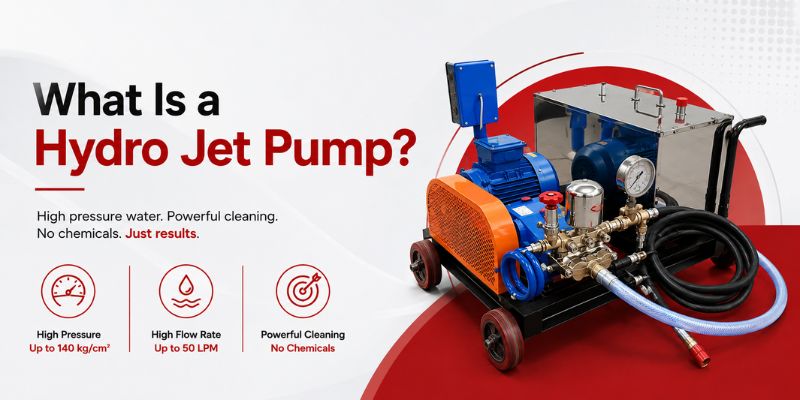
A hydro jet pump is a positive displacement pump that pushes water through a small nozzle at high pressure to cut, strip, and flush away deposits. Industrial units cover a wide pressure band depending on the job, from a few hundred PSI for light flushing to several thousand PSI and above for hard deposits and coating removal. Ambica’s water jetting pump range is built for plant cleaning duty with pressure up to 140 kg/cm2 (about 1,990 PSI) and flow up to 50 LPM. The jet does the cleaning, so no chemical goes into the waste stream.
Most industrial units use a plunger design. Ceramic-coated plungers move inside a stainless steel fluid end, and each stroke forces a fixed volume of water past a discharge valve. Ambica builds its hydro jet pump range on the same principle, with pressure up to 140 kg/cm2 and flow up to 50 LPM.
How Does a Hydro Jet Pump Work?
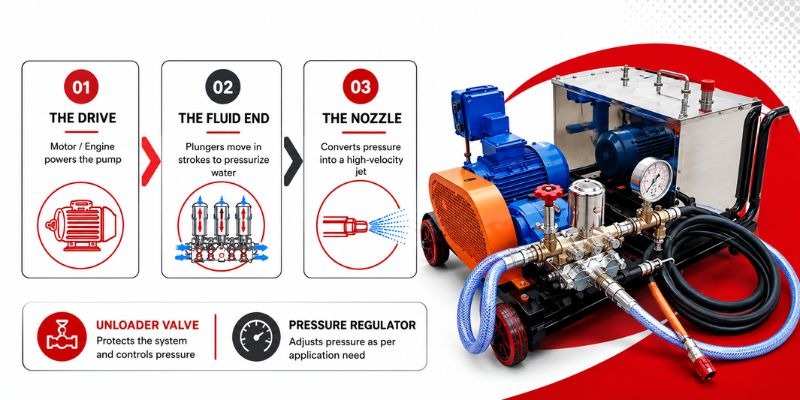
The drive: An electric motor or a petrol or diesel engine turns the crankshaft through a pulley and belt system. Engine-driven units go anywhere. Motor-driven units suit fixed plant use.
The fluid end: Two or three plungers draw water on the return stroke and push it out on the forward stroke. A triplex layout smooths the pulsation, which is why triplex plunger pumps dominate jetting work.
The nozzle: Pressure alone cleans nothing. The nozzle converts pressure into velocity, and nozzle size sets the split between pressure and flow. A small orifice raises pressure and cuts hard scale. A larger orifice raises flow and flushes loose debris faster.
An unloader valve and a pressure regulator sit between the pump and the lance so the operator can drop pressure without stopping the motor.
What Are the Main Uses of a Hydro Jet Pump?
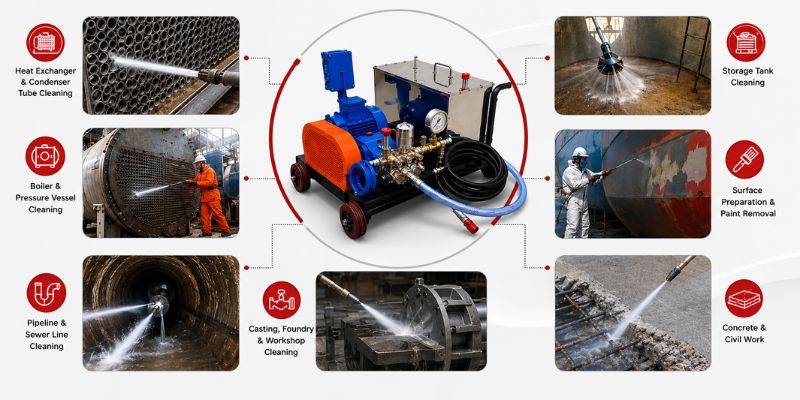
Heat exchanger and condenser tube cleaning
Scale inside exchanger tubes chokes heat transfer and pushes up fuel cost. A flexible lance with a rear-facing nozzle travels the tube bore and clears deposits without thinning the tube wall. Refineries, fertiliser plants, and sugar mills run this job at every shutdown.
Boiler and pressure vessel cleaning
Water side scale and fire side soot both respond to jetting. Plants clean boilers, drums, and pressure vessels before inspection so the surface reads clean for thickness testing.
Pipeline and sewer line cleaning
A jetting nozzle with rear jets pulls the hose forward while flushing grease, silt, and root mass back toward the manhole. Municipal teams and process plants use this for drains, effluent lines, and blocked headers.
Storage tank cleaning
Rotating jet heads lowered through a manway strip sludge from tank floors and walls. Crews spend less time inside the confined space, which is the safety argument that usually wins the purchase.
Surface preparation and paint removal
Water jetting strips paint, rust, and coatings ahead of repainting. Shipyards and railway workshops prefer it over grit blasting because there is no abrasive waste to collect and dispose of.
Casting, foundry, and workshop cleaning
Foundries knock out sand cores and clean casting surfaces with jetting. Railway workshops and airport ground crews use portable trolley-mounted units for the same reason: one operator, one hose, no chemical handling.
Concrete and civil work
Contractors use jetting to roughen concrete before an overlay, expose aggregate, and cut out damaged sections without shaking the rebar loose.
Hydro Jet Pump vs Hydrostatic Test Pump
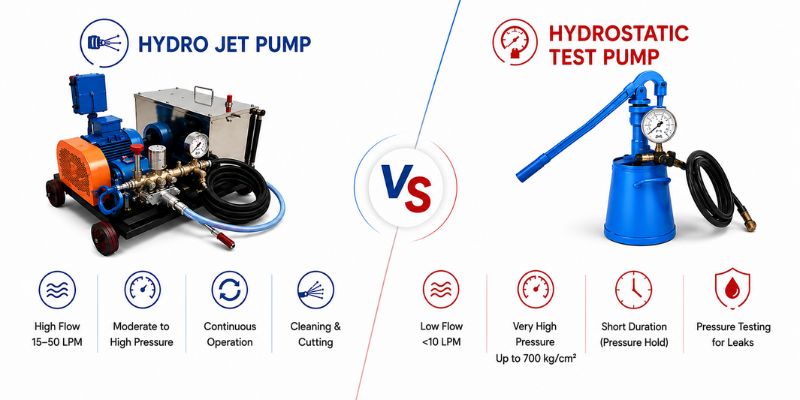
Buyers mix these two up often, and the mistake costs money.
| Hydro Jet Pump | Hydrostatic Test Pump | |
|---|---|---|
| Purpose | Cleaning and cutting | Pressure testing for leaks |
| Flow | High, 15 to 50 LPM | Low, often under 10 LPM |
| Pressure | Moderate to high | Very high, up to 700 kg/cm2 |
| Run time | Continuous | Short, pressure hold only |
A hydrostatic test pump fills a vessel, raises pressure, and holds it while an inspector looks for a drop on the gauge. Flow matters less than pressure stability. If you need the test side of the job, read the hydrostatic pressure test procedure first, since standards set the hold time and the test pressure for you.
How to Pick the Right Pressure Rating
Match the pump to the deposit, not to the highest number in the catalogue.
- Loose silt, dust, light grease: lower pressure with high flow does the work
- Hard scale in tubes, baked carbon: higher pressure with a smaller orifice
- Paint and coating removal: the highest pressure in the range, matched to the coating type and substrate
Flow decides how fast you finish. Pressure decides whether you finish at all. Our guide on choosing the right water jetting pump walks through the sizing maths with worked numbers.
Also check the fluid end material. SS 304 handles treated water and mild effluent. For seawater or acidic wash water, ask for a higher grade.
FAQs
What is a hydro jet pump used for?
A hydro jet pump cleans heat exchanger tubes, boilers, storage tanks, pipelines, and sewer lines, and it strips paint and rust before recoating. Water at high pressure removes the deposit, so no chemical enters the waste stream.
What pressure does industrial hydro jetting need?
It depends on the deposit. Light flushing needs relatively low pressure with good flow, hard scale removal needs higher pressure through a smaller orifice, and paint or coating removal sits at the top of the range. The right setting is chosen from the deposit type and the surface being cleaned, not from a single fixed number.
Is a hydro jet pump the same as a pressure washer?
No. A pressure washer runs on low flow and suits vehicles and floors. A hydro jet pump uses heavy-duty plungers, continuous-duty construction, and much higher flow for plant work.
Can a hydro jet pump damage pipes?
Not when the nozzle and pressure suit the pipe. Water at the right setting removes scale without cutting metal, which is why crews prefer it to mechanical rodding on thin-wall tubes.
Does hydro jetting need chemicals?
No. Water alone does the cleaning, which cuts disposal cost and keeps the effluent simpler to treat.
Conclusion
A hydro jet pump uses high-pressure water to remove scale, sludge, grease, paint, and other stubborn deposits from industrial equipment. The right pressure, flow, and nozzle help ensure effective cleaning without harsh chemicals.
For reliable hydro jet pumps and industrial cleaning solutions, contact Ambica Machine Tools at info@ambicamachinetools.com or call +91 9601253837.